It can be frustrating not to be able to make a car payment. In addition to the possibility of losing your preferred means of travel, a decline in your credit rating could make it more challenging to get affordable funding.
If you find yourself in this situation and your car payment is one of the bills worrying you, there may be a solution. Some lenders provide auto loan hardship programs to help those who are having financial difficulties.
Here are some measures you may take to help with car payments to obtain some relief and hopefully avoid some negative outcomes. So, let’s get started:
Measures To Take Help With Car Payments
The measures to take for Car payment assistance are given below. Do read!
-
Get In Touch With Your Lender
Informing your lender of your precarious financial condition may not seem like the most prudent course of action. The majority of lenders are, however, prepared to work with borrowers to bring their payments under control because car repossession tends to be the most time- and resource-intensive course of action when payments are not made.
Your lender may have more options to give you if you contact them sooner rather than later. You might begin by requesting the following small things:
Change In Due Date : A new due date may be the best course of action if your payday has changed or if you just need an extra week or two each month to have the money accessible.
Amendment Of The Payment Schedule : Your lender could agree to set up a payment schedule that works for you in order to prevent you from going into default. It might, for example, lengthen your loan term to decrease your monthly payments, divide your payments into smaller biweekly halves, or allow you to make up missing payments over time.
Be aware that these solutions may incur expenses and result in higher interest charges than you would otherwise experience. To prevent misunderstandings in the future, ask your lender about these possible consequences and receive updates in writing.
-
Make A Postponement Request
Ask your lender to consider delaying your auto payment if you’re having trouble making ends meet. If accepted, you will be able to miss a few payments without incurring any fines or penalties.
When it comes to delaying payments, each vehicle lender has their own set of guidelines and specifications. While some let you postpone your whole payment, others demand that you continue to pay interest. Some may also restrict the amount of deferral requests you may make or even forbid them altogether if you’re already behind on your payments. To learn about your possibilities, speak with your lender.
However, keep in mind that your lender will just add postponed payments to the end of your loan, which will result in you having to pay interest on your loan for a longer period of time. Nevertheless, it might still be preferable to have your car repossessed.
-
Refinance Your Car Loan
Refinancing your auto loan might offer you long-term relief if you have strong credit and owe less than the value of your vehicle. Replacing your current loan with a new one, frequently from a different lender, is known as refinancing.
Your ability to get a loan with a longer payback term than what is left on your present term, depending on your circumstances, could help lower your monthly payments. For instance, if your vehicle loan has 36 months remaining, you might refinance with a 48-month loan.
Just remember that adding time to your loan will usually mean paying more in total interest fees. Some lenders may also assess a penalty for repaying your loan early. Yet again, all of that could be worthwhile if you can prevent repossession and credit harm.
-
Sell Or Trade In Your Car
If refinancing is not a possibility and you want longer-term relief, selling the car can be beneficial. You might sell it to a private party or trade it in at a dealership in exchange for a secondhand car. Although trade-ins are frequently more practical, private-party transactions usually offer better value.
You may be able to get less insurance if you switch to an older vehicle in exchange for your present one. However, this choice might not be as effective if you owe more money on the car than it is worth.
-
Request A Loan From Friends Or Family
Asking for a short-term loan to meet your monthly payments until you can recover financially could be an option if you have an excellent connection with a person in your circle of friends who can help.
Requesting assistance from family or friends may seem awkward, so it’s crucial to be as official as you can. Even better, consider creating a contract with a predetermined payment schedule. Then, in order to prevent hurting the relationship, pay it back promptly or early.
-
Start A Side Business
Specifically, whether you choose decisions like driving for rideshare or food delivery services or offering labor through online marketplaces, starting a side business may help you quickly improve your income.
In order to make your income growth more predictable, you may also request overtime hours from your work or, if it’s not a temporary issue, look for a second job.
-
Surrender The Car
If you’ve already fallen behind on a few payments and your car is about to be repossessed, you might want to think about returning the vehicle to your lender.
Because you’re taking charge of your debt and making the decision to surrender, your credit scores will suffer far more from a voluntary surrender than they would from an involuntary repossession.
However, if there is a deficiency balance (your loan total less the amount the lender paid for your car at auction plus any additional costs), you will be responsible for paying it. If you are unable to pay, the lender can send the unpaid balance to collectors, which might negatively impact your credit.
What Is An Auto Loan Hardship Program?
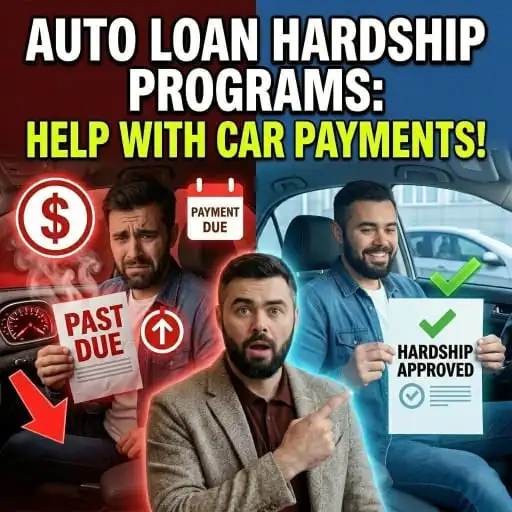
Auto Loan Hardship Programmes are assistance programs provided by lenders to borrowers who are having trouble making their auto loan payments due to financial hardship.
These initiatives offer temporary assistance and support to borrowers dealing with difficulties, including job loss, unforeseen medical costs, or unanticipated financial losses.
How Do Auto Loan Hardship Programs Work?
Auto Loan Hardship Programmes often involve a revision of the loan conditions, which may offer choices like payment delays, loan modifications, or lower interest rates.
To better suit the borrower’s current financial circumstances, lenders may provide borrowers the option to skip a specific number of monthly payments, prolong the loan’s term, or change the monthly payment amounts.
Who Qualifies For The Auto Loan Hardship Program?
Each lender’s auto loan hardship program may have different eligibility requirements.
However, in general, applicants who can show an actual inability to pay back their loan owing to unanticipated financial circumstances may be eligible.
This can involve serious significant events such as job loss, sickness, divorce, or other similar situations.
Downsides of The Auto Loan Hardship Program
Auto Loan Hardship Programmes may have certain drawbacks even though they might offer borrowers in financial difficulties much-needed assistance. Higher interest rates could be charged during the term of the loan, for instance, if the loan period is extended or the monthly payment amount is decreased. There can also be charges involved with taking part in these programs.
How Does The Auto Loan Hardship Program Affect Your Credit Score?
There shouldn’t be any immediate effects on credit scores from taking part in an auto loan hardship program.
Before enrolling in the program, it is crucial to discuss this with the lender. In some circumstances, the lender could inform credit bureaus of the modified loan conditions, which might have an impact on credit ratings.
Before joining the program, it’s essential to comprehend the lender’s policies completely.
Final Thoughts
The lender may immediately consider your account to be in default if you miss a car payment. Before incurring late fines, you could have a grace period of a few days.
Your lender may report the loan to the credit bureaus as overdue if you don’t make the payment within 30 days. The missing payment will begin to lower your credit score once it appears on your credit record.
Hope this post will help with your car payments. If you still have any doubts, please do comment and share with your friends and acquaintances.
Frequently Asked Questions
Does the Salvation Army help with car payments?
Famous NGO The Salvation Army provides Help with car payment assistance and support to needy individuals and families. Their goal is to give those who are going through difficult times support in the form of tangible aid, hope, and a sense of community. The Salvation Army provides a range of services, such as Help with car payments if unemployed.
Can I defer a car payment?
A payment deferment on a car loan will aid you in preventing repossession if you miss a payment. Your vehicle loan may occasionally include a deferral provision by default. However, you can’t postpone a car payment without your lender’s consent.
What is the average car payment in America?
For brand-new vehicles, the average monthly cost is $729. 40.72 percent of the vehicles funded in the second quarter of 2023 were new vehicles, with an average monthly auto payment of $528 for used cars.
Can a foreigner get a car loan in the USA?
Yes! Expats and foreign nationals can get vehicle loans in the US, but additional documentation is needed. Learn what is required to apply. If you’re transferring to the United States, you’ll want to purchase a car because the vast majority of the population lacks access to public transit.
How much is a down payment on a car?
Usually, you will be required to put down a minimum of 10% of the car’s worth. Some banks and lenders provide auto loans up to 90% of the on-road price. However, you will need to pay the difference between the on-road and ex-showroom prices as a down payment. Some lenders provide auto loans up to 100% of the ex-showroom price.